


The Global ITAD Alliance says the industry has moved from scrap to service. Buyers should notice.
If you have ever paid with a bank card, been treated at a hospital, or logged in at a school, your information has lived on devices that someone eventually had to retire securely. Most people never think about who handles that moment.
That blind spot is exactly what Darrell Fleming-Kendall, executive director of the Global ITAD Alliance, wants to fix. Speaking on the Resource Recycling Podcast on November 11, recorded live at E-Scrap: The Longevity Conference in New Orleans, he described a trade association whose mission is to raise awareness of IT asset disposition, or ITAD, well beyond the industry itself, especially among the general public and legislators.
It is a useful conversation for anyone who buys ITAD services, because it describes how the industry sees itself changing, and what that should mean for the way customers choose a partner.
An industry talking to itself
Fleming-Kendall’s starting point is simple. At industry conferences, he said, it is the industry talking to the industry. The Alliance, which launched in December 2025 with founding members that include ERI and SK tes, runs its own events, including the ITAD Summit in Las Vegas, ITAD Europe, and Mobile Disrupt. He said the most recent ITAD Summit drew 2,200 people and 146 vendors.
But a great deal of what shapes the industry happens outside those rooms, in legislatures, procurement offices, and public understanding. His argument is that anyone who has made an electronic transaction has been protected by an ITAD provider somewhere along the way, usually without knowing the industry exists. The Alliance wants to change how the industry talks about itself so that it resonates beyond its own audience.
From scrap to service
The most useful part of the interview for buyers is his account of how the industry has changed. He described an earlier era in which companies were recyclers in the traditional sense: collect material, sort it, take it apart, and send metals and plastics to separate buyers. Roughly five or six years ago, he said, the industry began shifting toward a service-first model, and certification programs such as e-Stewards and R2 helped drive that change.

The difference matters in practice. If your ITAD partner thinks of itself as a scrap business, your retired devices are a commodity. If it thinks of itself as a data-protection and brand-protection service, your retired devices are a liability it is helping you manage. Those two mindsets produce very different documentation, contracts, and accountability.

Why legislators are part of the picture
The host noted that US policy on this is a patchwork, with no federal framework, and Fleming-Kendall agreed. He said the Alliance’s message to legislators and regulators rests on three roles that ITAD plays:
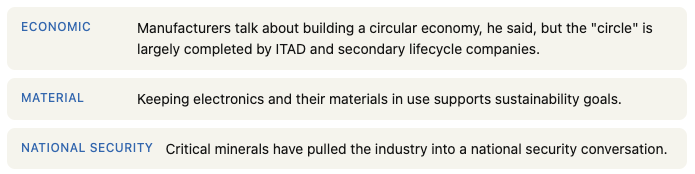
Most officials, he said, are simply looking to be educated. Rules are often proposed without a clear view of their secondary effects. He described attending an AI conference at a congressional office building a few weeks earlier, where 12 to 15 members of Congress spoke. He and two colleagues were, in his telling, the only ones raising what happens when AI and data center equipment reaches end of life, and he came away describing “a complete void in understanding” on the subject.
That observation deserves attention from IT leaders as well. If lawmakers who are actively debating AI and data centers are not yet focused on retirement, then organizations deploying that infrastructure cannot assume the rules, or the standards, will arrive in time to guide them.
Collaboration over competition
Fleming-Kendall also made a point about how the industry should behave while it grows. With demand expanding, he argued, providers gain more by collaborating than by fighting over share, because everyone’s piece grows when the whole market does. For customers, that is a hopeful sign. A more unified industry is more likely to produce consistent standards, clearer expectations, and easier ways to compare vendors.
There are signs of that already. Resource Recycling reported on November 4 that e-Stewards is developing an ITAD-specific standard, a development that fits the broader move toward defining what good ITAD practice looks like.
Five questions that follow from a service-first industry
If the industry now describes itself as a service that protects data and brands, buyers can reasonably test whether a vendor lives up to that description. Here are five practical questions to ask:
- Can you show device-level records? Ask for serialized documentation of what happened to each asset, not only a batch certificate with a generic reference number.
- How do you sanitize modern storage? Ask what methods are used on SSDs and NVMe drives, how results are validated, and which standard the process follows, such as NIST SP 800-88.
- What do your certifications actually cover? Ask which certifications the provider holds, which facilities and services they apply to, and when they were last audited.
- Where does everything go after pickup? Ask who handles your equipment at each step and how the chain of custody is documented through final disposition.
- What does the contract say about liability? A provider that protects your brand should be willing to spell out responsibilities for data handling, documentation, and what happens if something goes wrong.
Evaluating ITAD partners or planning a device retirement in California? Reboot Tech can walk you through what a documented, service-first program looks like.
Sources: Resource Recycling Podcast, “Global ITAD Alliance’s Darrell Fleming-Kendall: Expanding ITAD Awareness Beyond the Industry” (Nov 11, 2026); ERI and SK tes press releases on the Global ITAD Alliance launch (Dec 2025); Resource Recycling, “e-Stewards to develop an ITAD-specific standard” (Nov 4, 2026).