

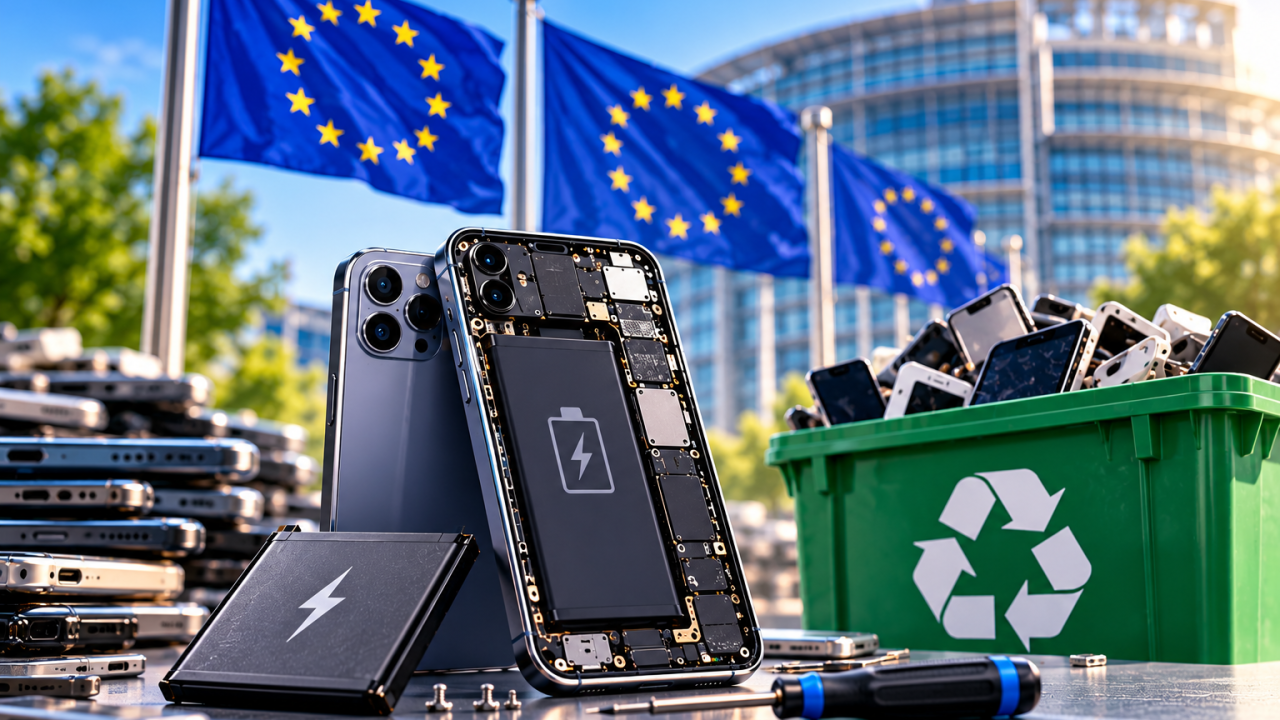
New European Union regulations are changing how smartphones are designed, repaired, and retired. The impact could extend far beyond Europe, reshaping the global electronics recycling and IT asset disposition (ITAD) industries.
For years, smartphone replacement cycles have been driven partly by declining battery performance, limited repair options, and the cost of replacing aging components.
The European Union is taking steps to change that model.
New requirements introduced in June 2025, followed by broader battery replaceability rules scheduled for August 2027, aim to make electronic devices last longer, improve repairability, and reduce unnecessary electronic waste.
But what happens when devices stay in circulation longer? And what does this mean for businesses managing thousands of retired smartphones?
A New Standard for Smartphone Battery Life
Under the EU’s 2025 ecodesign requirements, covered smartphones must retain at least 80% of their original battery capacity after 800 charging cycles.
Manufacturers must also make key replacement parts available for at least seven years after a phone model stops being sold in the EU.
These requirements are designed to reduce premature device retirement and make repairs more practical.
For businesses, this could mean extending smartphone replacement schedules, reducing equipment procurement costs, and increasing opportunities for refurbished devices.
A smartphone with a declining battery no longer has to be treated automatically as an end-of-life asset.
The 2027 Shift Toward Replaceable Batteries
Beginning August 18, 2027, broader EU battery regulations will generally require portable batteries in covered products to be removable and replaceable by end users.
However, this does not mean every smartphone must have a traditional pop-out battery.
Existing smartphone-specific rules provide exceptions for certain devices with enhanced water and dust resistance and sufficiently durable batteries. In those cases, professional battery replacement may remain permissible.
The objective is to improve repairability while accounting for product safety, performance, and durability.
For the electronics industry, this represents a shift toward designing products with maintenance and eventual recovery in mind.
What This Means for the ITAD Industry
Longer-lasting smartphones could change how organizations approach IT asset disposition.
Traditionally, aging mobile devices have been collected, assessed, and directed toward refurbishment, resale, parts recovery, or recycling.
Improved repairability could increase the number of devices suitable for a second lifecycle.
Three areas become particularly important:
- Device refurbishment: Replacing aging batteries could restore functionality and improve resale opportunities.
- Asset value recovery: Repairable devices may retain more value than equipment sent directly for material recycling.
- Responsible recycling: Devices that cannot be economically repaired still require safe battery handling, material recovery, and appropriate downstream processing.
This creates opportunities for ITAD providers capable of evaluating devices based on condition, security, repairability, and remaining market value.
Longer Device Lifespans Do Not Eliminate Data Security Risks
A smartphone can be physically functional and still contain sensitive business or personal information.
For companies retiring employee phones, healthcare devices, or enterprise mobile equipment, data security remains a critical part of the disposition process.
Before a smartphone is repaired for reuse, resold, or recycled, organizations need to consider:
- Secure data sanitization using an appropriate method
- Removal of mobile device management restrictions where authorized
- Asset tracking and documented chain of custody
- Verification of data destruction or sanitization outcomes
Repairability extends the hardware lifecycle. Secure ITAD protects the data throughout that lifecycle.
Could These Rules Influence the U.S. Market?
Although these regulations apply to covered products placed on the European market, their effects may reach manufacturers and secondary electronics markets worldwide.
Global smartphone brands could adopt similar repairability features across additional product lines, potentially making replacement parts more accessible and increasing the supply of repairable devices.
For U.S. organizations, including those in California, this is an important development to watch.
As device designs evolve, businesses may have more opportunities to recover value from retired smartphones rather than treating them as waste.
However, the U.S. market is not automatically subject to the same EU requirements, and outcomes will depend on manufacturer decisions and applicable local laws.
The Bigger Picture: From Device Replacement to Device Longevity
The future of electronics sustainability is not only about recycling more devices.
It is also about keeping functional technology in use for longer.
Repairable batteries, longer software support, accessible replacement parts, and responsible IT asset disposition can work together to reduce unnecessary electronic waste.
For the ITAD industry, the opportunity is to support the entire technology lifecycle — from secure collection and evaluation to refurbishment, remarketing, data destruction, and responsible recycling.
The next generation of sustainable technology may not be defined by how quickly devices are replaced, but by how effectively their useful lives are extended.
Retiring business smartphones or other IT equipment in California? Plan secure collection, data sanitization, and responsible asset recovery with Reboot Tech LLC.
Sources
- European Commission — New EU rules for durable, energy-efficient and repairable smartphones and tablets, June 20, 2025.
- European Commission — Smartphones and Tablets Ecodesign Requirements, Regulation (EU) 2023/1670.
- European Union — Batteries Regulation, Regulation (EU) 2023/1542, Article 11.