

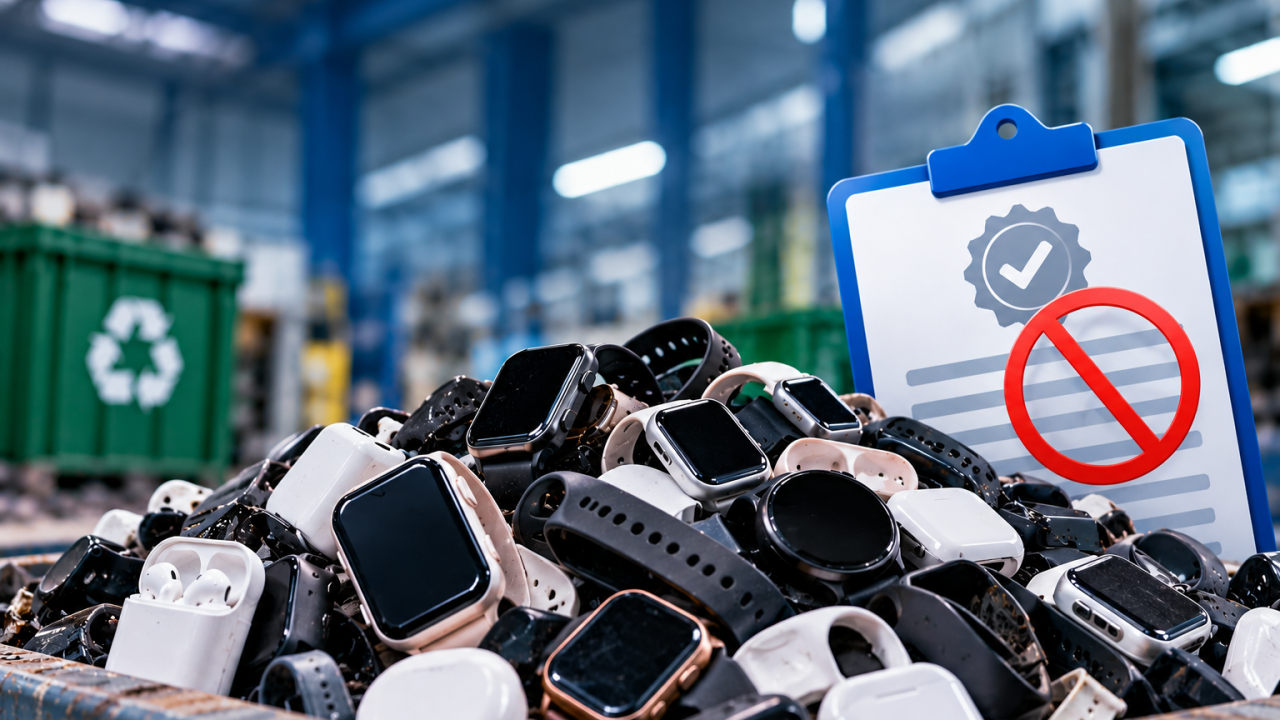
Smartwatches, fitness trackers, and medical wearables hold your most sensitive data. The ITAD industry isn’t ready for them. Is your organization?
There’s a device on your wrist that knows more about you than almost any other piece of technology you own.
It knows your resting heart rate. Your sleep patterns. Your location, tracked continuously. Your payment credentials. In healthcare environments, it may know your ECG readings, your blood oxygen, your medication schedule. In enterprise settings, it may be enrolled in mobile device management and hold corporate access credentials.
When that device gets replaced in two to four years — which is the standard refresh cycle for smartwatches and fitness bands — what happens to all of that data?
That question was front and center at E-Scrap: The Longevity Conference in New Orleans last week. And the honest answer from industry analysts is uncomfortable: the ITAD industry doesn’t yet have a standardized process for handling wearables. The organizations issuing these devices are already ahead of the disposal infrastructure that will eventually handle them.
The scale is bigger than most IT teams realize

Most IT teams think of wearables as personal consumer devices. That mental model is increasingly wrong. Corporate wellness programs issue fitness trackers to employees. Healthcare systems issue clinical-grade wearables to nurses and physicians. Field service organizations track workers through connected wearables. And with camera-equipped smart glasses arriving within eighteen months, the enterprise category is about to expand significantly.
Every one of those devices accumulates sensitive data. Every one of them eventually reaches end-of-life. And the volume — smartphone-scale — means this is not a niche problem. It is an imminent one.
“While wearables are small, we expect volumes to be massive. The explosion of wearables has driven an unprecedented demand for used devices — but the disposition side has not matched the pace of adoption.”
— Industry analyst, Resource Recycling, October 2026
What’s actually sitting on these devices
The data sensitivity of wearables is what makes them genuinely different from the enterprise IT assets most ITAD programs are built to handle. A laptop holds documents and credentials. A wearable holds something more intimate — continuous biometric and behavioral data collected passively, often without the user fully appreciating what is stored locally on the device.
Smartwatches and fitness trackers hold heart rate logs, sleep patterns, location history, payment credentials, and — in enterprise deployments — corporate access tokens. Clinical wearables in healthcare environments hold ECG data, blood oxygen readings, patient monitoring logs, and medication schedules. Camera-equipped wearables will add video footage and audio recordings to that list.
The FTC already moved on this: In July 2024, the FTC tightened its Health Breach Notification Rule to explicitly cover fitness trackers and wearable health apps — including those outside traditional HIPAA scope. Organizations issuing wearables as part of corporate wellness programs now face federal notification obligations if that health data is exposed. Most don’t know it yet.
Why the industry doesn’t have a standard answer yet
The wearables disposal challenge is architecturally different from anything the ITAD industry’s current processes were designed for — and that’s the honest reason standardized protocols don’t exist yet.
An enterprise-managed fleet of Apple Watches may have a workable path: Apple Watch supports remote erase through mobile device management, so a fleet that stayed enrolled in MDM can be wiped before physical disposal. That’s manageable.
But a mixed load of smart rings, fitness trackers from multiple manufacturers, industrial wearables, and AR glasses arriving without their original accounts or paired phones is a different problem entirely. Each device has different storage architecture. Factory reset — the default approach most organizations take — does not guarantee complete data removal across all wearable platforms. And unlike laptops or smartphones, there are no NIST SP 800-88 Rev. 2 guidance documents specifically addressing wearable sanitization.
The physical construction adds another layer. Wearables are universally built with embedded lithium-ion batteries, bonded screens, and glued cases — designed for miniaturization, not disassembly. That makes material recovery harder and creates a battery fire risk in standard recycling streams. Under California SB 1215, effective January 1, 2026, virtually every wearable falls under California’s covered e-waste program. Standard disposal channels are no longer legal.
California IT and healthcare teams: Battery-embedded devices — including every smartwatch and fitness tracker — now require disposal through California’s covered e-waste program under SB 1215. Combined with HIPAA, the FTC Health Breach Notification Rule, and the California Confidentiality of Medical Information Act, a single improperly disposed clinical wearable can trigger obligations under four separate compliance frameworks simultaneously.
What your organization should do right now
The industry’s lack of a fully standardized wearables process doesn’t mean waiting for one. It means asking harder questions and building the internal discipline that protects you while the industry catches up.
- Inventory every wearable your organization has issued. Most IT asset inventories don’t include wearables. That gap is a compliance gap. Every issued device — regardless of form factor — belongs in your inventory and needs a tracked lifecycle through to certified disposal.
- Keep wearables enrolled in MDM throughout their operational life. MDM enrollment is currently the most reliable path to verified data removal on managed wearables. Devices that leave MDM before disposal — because an employee exits, because IT missed the offboarding — are significantly harder to sanitize to a defensible standard.
- Don’t rely on factory reset as your data destruction standard. Factory reset removes user-visible data. It does not guarantee complete removal on all wearable platforms, particularly for devices with persistent health logs, payment tokens, or cached corporate credentials. Verify what method your ITAD partner applies — and what evidence they provide.
- Ask your ITAD partner specifically about wearable handling. Not all certified operators have developed processes for the full range of wearable categories. Ask what device types they handle, what sanitization method they apply to each, and what chain-of-custody documentation they provide. The answer tells you a great deal about their operational maturity.
The smallest device, the biggest blind spot
The device on someone’s wrist may be the smallest piece of hardware in your IT fleet. It may also be carrying the most sensitive data — biometric, behavioral, clinical, financial — your organization holds about that individual.
It deserves the same certified disposal process as the largest server in your data center. Right now, in most organizations, it isn’t getting one.
At Reboot Tech Recycling, we work with enterprise and healthcare organizations across California to build IT asset disposition programs that cover the full device inventory — including the wearables that traditional ITAD programs have historically overlooked. As the industry develops standardized wearables processes, we help our clients stay ahead of the compliance curve.
The device on your wrist knows a great deal about you. When it retires, make sure you know exactly where it goes.
Managing wearables, enterprise devices, or healthcare IT hardware in California? Let’s build a certified, documented disposal plan that covers your full fleet.