

The fee raised more than regulators projected. Here’s what it means for retailers and IT buyers.
Buy the same $1,200 laptop in California on December 31 and again on January 2, and the battery recycling fee on it could differ by $14.
That is the practical effect of a rule change CalRecycle plans to finalize this month. According to Resource Recycling’s November 2 report, the agency intends to drop the per-item cap on California’s embedded battery fee from $15 to $1, effective January 1, 2027. The rate itself stays at 1.5% of the retail price.
The change is small on paper and useful to understand, especially for retailers, procurement teams, and anyone planning device purchases or retirements in the first quarter of 2027.
A quick refresher on the fee
SB 1215, signed in September 2022, expanded California’s Electronic Waste Recycling Act to cover products with non-user-removable batteries. Since January 1, 2026, retailers have collected a recycling fee at checkout on new and refurbished covered battery-embedded products. It is 1.5% of the retail sales price, capped at $15 per product in 2026. Retailers remit the fees to the California Department of Tax and Fee Administration and may keep 3% to cover their collection costs.
Resource Recycling describes the program as a consumer-funded, state-run fee system rather than extended producer responsibility. That distinction matters for how it differs from the battery laws emerging in other states.
What the cap change does to the numbers
Because the rate stays at 1.5%, the new $1 cap takes effect on any product priced above $66.67. Below that price, nothing changes.
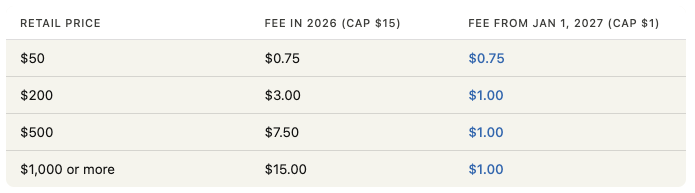
llustrative calculations at 1.5% of retail price using the current $15 cap and the proposed $1 cap. CDTFA’s November 2026 guidance for retailers uses the same math.
In practice, most laptops, tablets, game consoles, and similar mid-to-high-priced devices will carry a flat $1 fee. Low-priced items keep paying the percentage.
Why California is making the change

The reason is straightforward: the fee brought in more revenue than regulators projected in its first year. SB 1215 gave CalRecycle authority to adjust the fee annually beginning August 1, 2026. At a public workshop on June 17, the agency recommended lowering the cap while keeping the 1.5% rate, and an informal comment period followed.
As of Resource Recycling’s reporting, the rule was with the agency’s legal staff, with approval expected in November. CDTFA has already published a November 2026 notice for retailers describing how the $1 cap will work starting January 1, which suggests the transition is well underway.
What the fee is not: It is a point-of-sale funding mechanism for the state’s recycling program. It does not replace an organization’s own obligations for the devices it retires. Data destruction, chain-of-custody documentation, and compliance with frameworks like HIPAA and NIST SP 800-88 are separate from this fee, and paying it at purchase does not address any of them.
Dates worth putting on the calendar
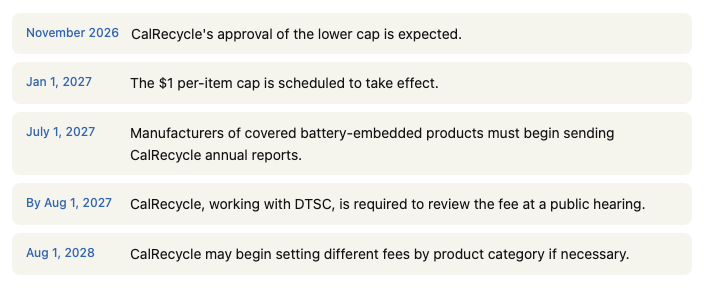
The bigger picture: California is still the outlier
Resource Recycling’s coverage notes that California is the only state with a current embedded battery requirement, while more than 20 battery EPR laws are on the books across 16 states and 17 bills were introduced in eight states this year. A separate November 2 roundup on electronics legislation describes states retooling their programs to keep up with new device types, including Wisconsin adding wearables.
For organizations operating in several states, the takeaway is that rules for battery-embedded devices are still moving. A lower California fee does not signal a lighter regulatory direction. It signals a program being tuned after its first year.
What to do before January 1
- Retailers and resellers: update point-of-sale logic to apply 1.5% with a $1 cap from January 1, and keep the fee as a separate line item on receipts and invoices, as CDTFA requires.
- Procurement and finance teams: review device budgets for Q1 2027 and confirm with your tax advisor how the fee appears on invoices for business purchases. Lower fees on higher-priced devices are a small line item, but they are worth modeling.
- Manufacturers and brands: confirm your covered and exempt product lists and prepare for the July 1, 2027 reporting start.
- IT asset managers: keep a serialized inventory of battery-embedded devices, including laptops, tablets, and wearables, and plan their retirement separately from the purchase-time fee.
- Everyone: do not treat the fee as a disposal plan. It funds a state program. Your data security and documentation responsibilities stay with you.
The takeaway
California’s embedded battery program is entering its second year with a lower cost at checkout for most devices and a clear schedule of reporting and review dates ahead. For IT and sustainability teams, the fee itself is minor. The more useful signal is that the rules around battery-embedded products are being actively adjusted, and organizations that keep clean inventories and documented retirement processes will have an easier time adapting.
Reboot Tech LLC supports secure IT asset disposition, NIST 800-88-aligned data destruction, serialized reporting, value recovery, and responsible electronics recycling for California organizations. Visit reboottechrecycling.com or call (626) 608-5354 to plan a secure pickup or device retirement project.
Planning a device refresh or retirement in California? Let’s build a documented plan that covers purchase, inventory, and end of life.
Sources: Resource Recycling, “California to cut embedded battery fee cap” (Nov 2, 2026); CDTFA publication L-1047, “Changes to the Covered Battery-Embedded Waste Recycling Fee Rate Effective January 1, 2027” (Nov 2026); CalRecycle, SB 1215 Covered Battery-Embedded Products program page; CalRecycle public notices on the fee rulemaking.